
Learn · TRT
Enclomiphene, explained: the TRT alternative that preserves fertility
One quiet difference sets enclomiphene apart from testosterone therapy: instead of replacing testosterone from outside, it prompts your body to make more of its own — which is why men who still want to father children keep asking about it. Here's the honest version, labs first.
See the TRT OptionsGeneral information, not medical advice · A medical provider licensed in your state makes every medical decision
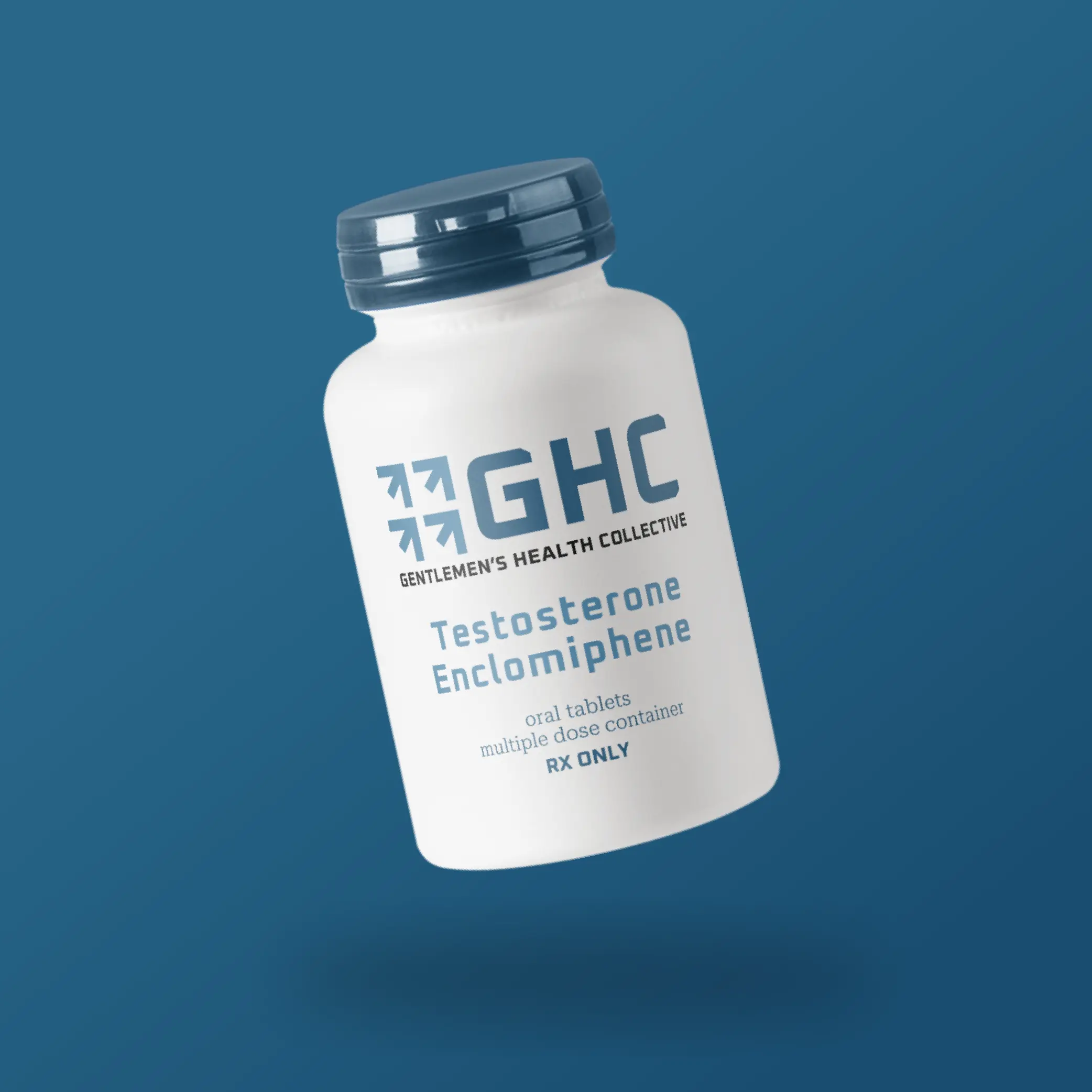
Enclomiphene at a glance
The honest status, up front — no hype, no hedging.
What's true today
Enclomiphene is one of the two molecules that make up clomiphene — a selective estrogen receptor modulator (SERM) that works at the brain, not the testes.
Not FDA-approved for raising testosterone. Used for that purpose, it's prescribed off-label and typically compounded by a state-licensed pharmacy.
It nudges your body to make more of its own testosterone — so it tends to preserve fertility rather than suppress it, unlike external testosterone.
It's taken orally, not injected — and it relies on a testicular axis that still responds.
Whether it fits you is a decision made by a medical provider licensed in your state, after labs — not a foregone conclusion.
← All guides
Reviewed against primary sources. Every clinical claim below is checked against FDA labeling, clinical-society guidelines, or peer-reviewed literature — 8 sources cited, last reviewed 2026-07-15.
Enclomiphene is a medication some men use to raise their own testosterone from the inside out — rather than replacing it from outside the body the way traditional testosterone therapy does.[1] That single mechanical difference is why enclomiphene gets so much attention from men who want to address low testosterone but still want to father children. Be clear on one thing up front: enclomiphene is not an FDA-approved drug in the United States.[2] Where it is used to raise testosterone, a licensed provider prescribes it off-label, and it is typically compounded. Below, we explain what it is, how it works, how enclomiphene vs TRT actually differs, and the honest trade-offs — starting with labs, not promises.
What is enclomiphene?
Enclomiphene is a component of clomiphene. It is, like clomiphene, a selective estrogen receptor modulator (SERM).[3] It works at the brain-and-pituitary end of the system rather than at the testes. Enclomiphene has no FDA-approved labeling of its own, and therefore no FDA-approved indication. Clomiphene is FDA-approved, but its labeled indication is the treatment of ovulatory dysfunction in women.[4] That is the whole regulatory picture, and it is why men who take enclomiphene for testosterone are taking an unapproved drug off-label, usually as a compounded preparation.
How does enclomiphene raise testosterone?
Does enclomiphene raise testosterone? In men whose axis still responds, yes — indirectly. Like clomiphene, enclomiphene antagonises estrogen receptors, which reduces estrogen’s negative feedback on the hypothalamic-pituitary axis, increases gonadotropin secretion — LH and FSH — and stimulates the body’s own testosterone production. In a 2025 systematic review and meta-analysis of randomized controlled trials of clomiphene or enclomiphene citrate for the treatment of male hypogonadism (Hohl, Chavez, Pasqualotto and colleagues, 2025), SERM therapy significantly improved total testosterone, LH, and FSH in men with functional hypogonadism compared with placebo, and improved LH and FSH compared with testosterone gel.[5] Individual results vary.
Enclomiphene vs TRT — what’s the difference?
The core of the enclomiphene vs TRT question is direction. The published enclomiphene research describes conventional TRT with exogenous androgens as suppressing the hypothalamic-pituitary-gonadal axis, causing testicular atrophy, and impairing spermatogenesis.[7] In those same studies, enclomiphene stimulates endogenous gonadotropin release instead of shutting it down. That is what makes it appealing to men worried about fertility, and it is also why it depends on an axis that still works.
Does enclomiphene protect sperm production?
This is the enclomiphene fertility angle men actually search for, and it deserves a precise answer rather than a marketing one. In a 2025 review of innovations for preserving spermatogenesis in testosterone deficiency (Hochu, Geyer-Kim and Kim, 2025), enclomiphene citrate stimulates the hypothalamic-pituitary-gonadal axis, increasing endogenous testosterone while maintaining spermatogenesis — sperm production. The same review describes conventional testosterone replacement as restoring serum testosterone but suppressing gonadotropins, resulting in impaired spermatogenesis.[9] That contrast is enclomiphene’s most-cited benefit. But note what that is and is not: it is a difference in mechanism, not a promise about any individual man’s fertility. In a retrospective case series of 15 men treated with sublingual enclomiphene citrate, the authors state plainly that because the study lacked a control group and long-term monitoring, fertility preservation and HPG-axis effects could not be determined.[10] Individual results vary.
What are the side effects of enclomiphene?
Enclomiphene has no FDA-approved labeling, so there is no FDA-reviewed adverse-reaction list for it — a real gap, and one worth saying out loud. The nearest regulated reference point is clomiphene, the approved drug enclomiphene is a component of. Clomiphene’s FDA labeling reports visual symptoms — blurred vision, lights, floaters, photophobia — as adverse reactions, along with nausea and vomiting, headache, and, less commonly, depression, dizziness, and fatigue.[11] Tell your medical provider about any vision change straight away. On enclomiphene itself the published safety record is thin: in a retrospective case series of 15 men treated with sublingual enclomiphene citrate, no serious adverse events were documented over the 60-day study period — but that study had no control group and no long-term safety monitoring, so it cannot settle the safety question.[12] Blood counts and hormone levels should be monitored. It is not appropriate for everyone.
Why the fertility question matters so much
Most men do not think about sperm when they think about testosterone — until a medical provider raises it. The Endocrine Society clinical practice guideline recommends testosterone therapy for men with symptomatic testosterone deficiency, and it recommends against starting testosterone therapy in men who are planning fertility in the near term.[13] That is the trade-off in one line, from the guideline itself. For a man who may still want children, it is a real decision, not a footnote. Enclomiphene’s appeal is that it aims at the same problem — genuinely low testosterone — through a pathway that stimulates the gonadotropins rather than suppressing them.
The honest limits and enclomiphene benefits
The enclomiphene benefits men care about are straightforward. In the Hochu review, enclomiphene citrate increases endogenous testosterone while maintaining spermatogenesis.[14] It is taken orally rather than injected. But it is not a universal answer. In that same meta-analysis, the randomized-trial evidence for clomiphene and enclomiphene sits in men with functional hypogonadism, compared against placebo, testosterone gel, or hCG.[16] Its pathway runs through the pituitary, so where the testes themselves have failed it has no signal to amplify — a limit those trials do not test.[17] We also do not prescribe it as a bodybuilding shortcut, as an anti-aging product, or to men whose testosterone is already normal. And its off-label, compounded status means it carries no FDA approval for this use. This is exactly why any responsible protocol is labs-first.
Labs come first — always
Low-testosterone symptoms — low energy, low drive, poor sleep, low libido — are not specific to testosterone. That is why a blood draw comes before any prescription, and why the Endocrine Society guideline recommends diagnosing hypogonadism only in men with symptoms and signs consistent with testosterone deficiency and unequivocally and consistently low serum testosterone.[18] It recommends measuring fasting morning total testosterone as the initial diagnostic test and confirming the diagnosis by repeating that measurement.[19] If you want to understand what those numbers mean, read our guide to the testosterone panel. Understanding how TRT works — and the honest TRT side effects — helps you weigh enclomiphene against replacement in a real conversation with a medical provider. You can explore both paths on our testosterone care pillar.
How to actually get started
Through our intake platform, the flow is the same discipline we apply to all hormone care: you complete an intake, get bloodwork done (at-home kit, a local lab, or by uploading recent results), and a licensed medical provider reviews everything. A prescription — enclomiphene, testosterone, or neither — is issued only where it is clinically appropriate, and dispensed by a pharmacy licensed in your state. There are no guarantees, and not every man is a candidate.
FAQ
Is enclomiphene FDA-approved for raising testosterone?
No. Enclomiphene is not an FDA-approved drug, and it has no FDA-approved indication for any use. When it is used to raise testosterone it is prescribed off-label and is often a compounded medication. A licensed medical provider decides whether it is appropriate based on your labs and symptoms.
Is enclomiphene better than TRT?
Neither is universally “better.” Enclomiphene may suit men who want to keep sperm production running and still have a responsive testicular axis; standard TRT may suit others. The enclomiphene vs TRT choice depends on your bloodwork, goals, and medical history. Individual results vary.
Can enclomiphene affect sperm count?
In the published literature, enclomiphene increases endogenous testosterone while maintaining spermatogenesis, whereas conventional testosterone replacement suppresses gonadotropins and impairs spermatogenesis. That is the main reason enclomiphene is discussed as a fertility-sparing option. It is a mechanism difference, not a guarantee, and outcomes differ between individuals.
How is enclomiphene taken?
Enclomiphene is taken orally, not injected. Dosing and duration are determined by the prescribing medical provider and adjusted based on follow-up labs and how you respond.
What monitoring does enclomiphene require?
Expect follow-up bloodwork to track testosterone, estradiol, LH, FSH, and blood counts, plus a check-in on symptoms and any side effects such as vision changes or mood shifts. Ongoing monitoring is part of responsible treatment.
Who should not take enclomiphene?
Men whose testosterone is already normal, and those whose low testosterone stems from testicular failure rather than a brain-signal issue, are often poor candidates. It is not for bodybuilding or anti-aging. Only a licensed medical provider can determine suitability after reviewing your labs.
Gentlemen’s Health Collective operates under exclusive partnership with OpenLoop Health, an independent network of licensed medical providers. All medical decisions are made by your assigned, licensed medical provider. Medications are dispensed through partnered pharmacies licensed in your state. Not all treatments are appropriate for all patients. Treatment availability varies by state. Compounded medications are not FDA-approved. They are prepared in FDA-regulated facilities. Individual results vary. Prescriptions are issued at the sole discretion of a licensed provider, and only where clinically appropriate. This article is for general information and is not medical advice. Talk to a licensed medical provider about your situation.
Sources & Evidence
- 1Changes in Serum Testosterone After Sublingual Enclomiphene Citrate Combined With a Mineral Oxide Delivery System: A Retrospective Case Seri (Warren S., 2026)
“Changes in Serum Testosterone After Sublingual Enclomiphene Citrate Combined With a Mineral Oxide Delivery System: A Retrospective Case Seri (Warren S., 2026) · Preserving spermatogenesis in testosterone deficiency: innovations in replacement and stimulatory therapies. (Hochu G, ”
- 2openFDA drug label index
“no approved labeling found for "Enclomiphene"”
- 3DoD Operation Supplement Safety (OPSS)
“Clomiphene and Enclomiphene Are Drugs, Not Dietary Supplements — Clomiphene and Enclomiphene: Drugs, Not Dietary Supplements Skip to Main Navigation Skip to Search Skip to Instagram USU | CHAMP sites: HPRC OPSS x Ask the Expert INGREDIENTS”
- 4Clomiphene Citrate (CLOMIPHENE CITRTAE)
“FDA label, INDICATIONS AND USAGE”
- 5Clomiphene Citrate in off-Label Post-Cycle Therapy: Mechanisms, Efficacy and Diagnostic Challenges in Endocrine Recovery Following Anabolic (Bandura A, Furka S
“Clomiphene Citrate in off-Label Post-Cycle Therapy: Mechanisms, Efficacy and Diagnostic Challenges in Endocrine Recovery Following Anabolic (Bandura A, Furka S, Hromníková D et al., 2026) · Changes in Serum Testosterone After Sublingual Enclomiphene Citrate Combined With a Miner”
- 6Preserving spermatogenesis in testosterone deficiency: innovations in replacement and stimulatory therapies. (Hochu G, Geyer-Kim I, Kim E., 2025)
“Preserving spermatogenesis in testosterone deficiency: innovations in replacement and stimulatory therapies. (Hochu G, Geyer-Kim I, Kim E., 2025)”
- 7Endocrine Society Clinical Practice Guideline
“Testosterone Therapy in Men With Hypogonadism (Bhasin et al., 2018, PubMed) — Testosterone Therapy in Men With Hypogonadism: An Endocrine Society Clinical Practice Guideline - PubMed Clipboard, Search History, and several other advanced f”
- 8Pharmacological Modulation of Orthodontic Tooth Movement: Mechanisms, Clinical Implications, and Emerging Therapeutic Approaches. A Review. (Pacheco-Quito EM, F
“Pharmacological Modulation of Orthodontic Tooth Movement: Mechanisms, Clinical Implications, and Emerging Therapeutic Approaches. A Review. (Pacheco-Quito EM, Flores-Regalado C, Lima-Illescas M et al., 2026) · Sex-informed estrogen receptor modulation in schizophrenia: a male-foc”
Editorial standards. Gentlemen's Health Collective content is written to be medically honest and independently sourced. A claim is only published once a primary source has been fetched and confirmed to support it; claims that cannot be independently verified are removed or routed for clinical sign-off. We describe process, not individuals.
How getting started actually works
Complete an intake
Share your symptoms, history, and goals through the intake platform — the same discipline applied to all hormone care.
Get bloodwork done
An at-home kit, a local lab, or uploading recent results. Low-T symptoms overlap with thyroid problems, sleep apnea, and depression — so numbers come before any prescription, usually a morning test, often repeated.
A licensed provider reviews everything
A medical provider licensed in your state reads your labs and symptoms and decides what's appropriate — enclomiphene, testosterone, or neither.
Dispensed only where appropriate
If a prescription fits, it's dispensed by a pharmacy licensed in your state. There are no guarantees, and not every man is a candidate.
Want to know where you actually stand?
Enclomiphene, testosterone, or neither — the honest first step is the same: real labs and a medical provider licensed in your state reading them. See the TRT options, then start the assessment. It's free.
See the TRT Options Start Your AssessmentGentlemen’s Health Collective is a men’s telehealth marketing platform and does not provide medical services. Medical care is provided by our medical provider partner, an independent network of US-licensed medical providers; all medical decisions are made by a medical provider licensed in your state. Compounded preparations are not FDA-approved for these specific formulations; they are dispensed by state-licensed compounding pharmacies operating under USP <795> and/or USP <797> standards and are distinct from FDA-approved, brand-name products. Enclomiphene is not FDA-approved for raising testosterone and, when used for this purpose, is prescribed off-label. Individual results vary. This page is general information, not medical advice. Prescription medications require medical evaluation and are prescribed only when appropriate. 100% self-pay. If you are experiencing a medical emergency, call 911.